
Why Are Transitions So Hard for My Child?
How to support children with ADHD or autism through everyday changes using structure and calm cues

At a Glance
- Transitions trigger stress for children who struggle with flexibility or sensory processing.
- Structure, prep cues, and co-regulation help the brain shift gears.
- These aren’t behavior issues—they’re brain-based challenges.
What Makes Transitions Difficult
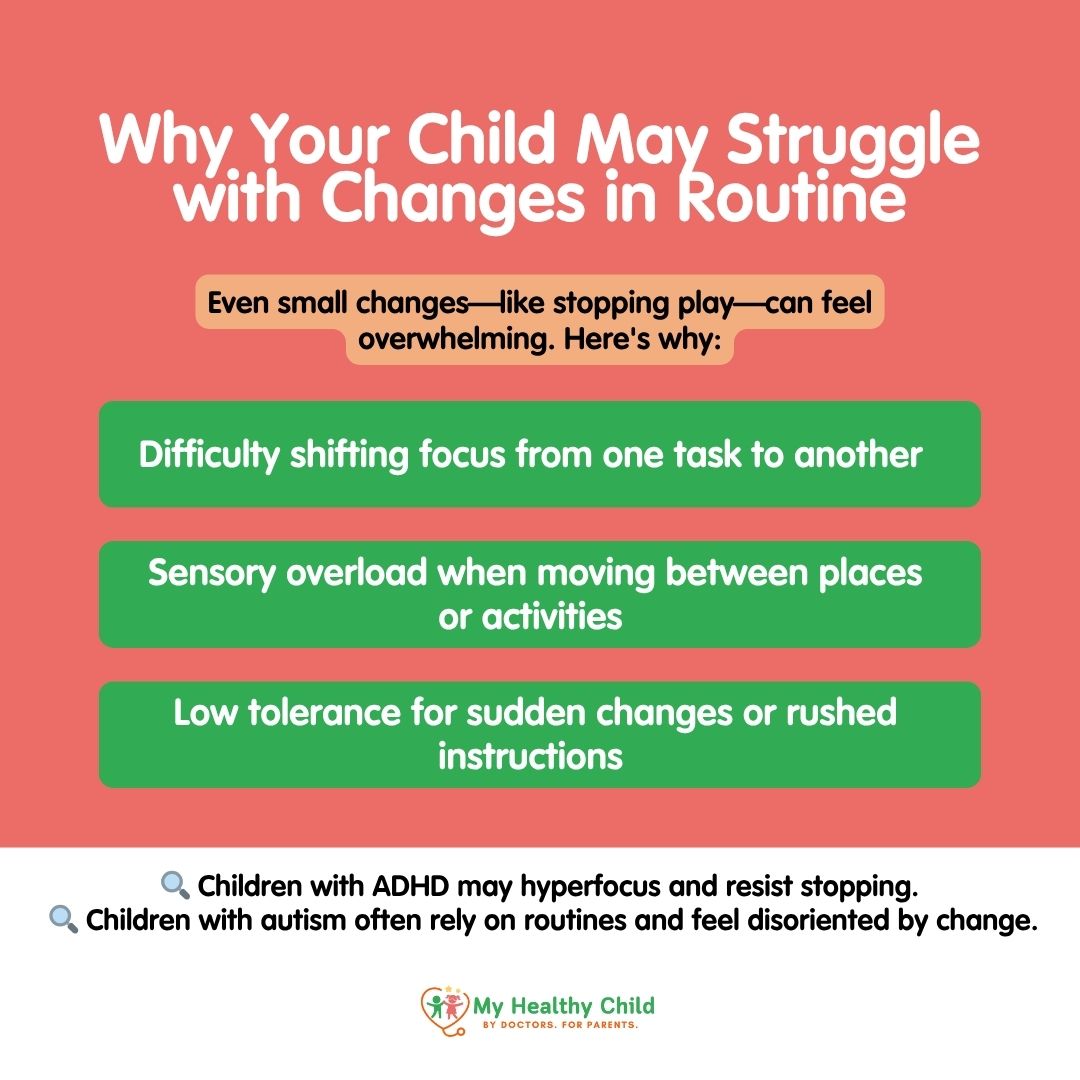
For neurodivergent children, even small changes—like stopping play to brush teeth—can feel overwhelming. This is due to:
- Difficulty shifting attention or letting go of focused tasks
- Sensory overload when moving between spaces or settings
- Low tolerance for unpredictability or rushed instructions
Children with ADHD often hyperfocus and resist breaking momentum. Children with autism may cling to routines and feel disoriented by shifts in activity.
What Predictable Routines Actually Do
Routines offer a mental map of the day. When kids know what’s coming, they’re less likely to panic or resist. Pediatric therapists recommend:
- Keeping the order of events consistent (e.g., bath → pajamas → story), even if exact timing varies
- Using visual aids: charts, pictures, or first-then boards
- Keeping transitions short, quiet, and cue-based—not rushed
This helps anchor the nervous system and gives children a sense of control.
Pediatric Strategies That Help
- Advance warnings – “In 5 minutes, we clean up.” Repeat once. Use a visual timer if needed.
- First–Then phrasing – “First shoes, then outside.” It reduces negotiation and supports sequencing.
- Anchor rituals – Use a small cue before transitions: a song, stretch, or deep breath. These bridge tasks gently.
- Watch for sensory triggers -Is the new setting louder, colder, brighter? Is clothing uncomfortable? OT support may be helpful for kids who react strongly to sensory shifts.
- Model calm co-regulation – Your slow voice, steady presence, and simple words help your child borrow calm.
What to Do Next: Guidance for Parents
- Add a visual schedule or anchor cue to your child’s most challenging transition.
- Keep notes on which transitions are hardest and when meltdowns happen.
- Ask your pediatrician or OT if sensory input or flexibility is a factor.
Note:
This article was medically reviewed and written in collaboration with doctors and medical professionals committed to providing pediatric developmental health education.
References:
U.S. Centers for Disease Control and Prevention (CDC)
CHADD (Children and Adults with Attention-Deficit/Hyperactivity Disorder)

Francis Xavier M. Dimalanta, MD, FPPS, FPSDBP
Developmental and Behavioral Pediatrician
Fellow, Philippine Pediatric Society
Fellow, Philippine Society for Developmental and Behavioral Pediatrics
Head, Section of Developmental and Behavioral Pediatrics
Institute of Pediatrics and Child Health
St Luke’s Medical Center - Quezon City and Global City
Medical Director, A Child’s DREAM Foundation, Inc (est. 2003)
Disclaimer:
The information in this article is intended for educational purposes only and does not substitute professional medical advice, diagnosis, or treatment. Always consult your physician, pediatrician, or qualified healthcare provider with any questions you may have regarding a medical condition or health objectives.