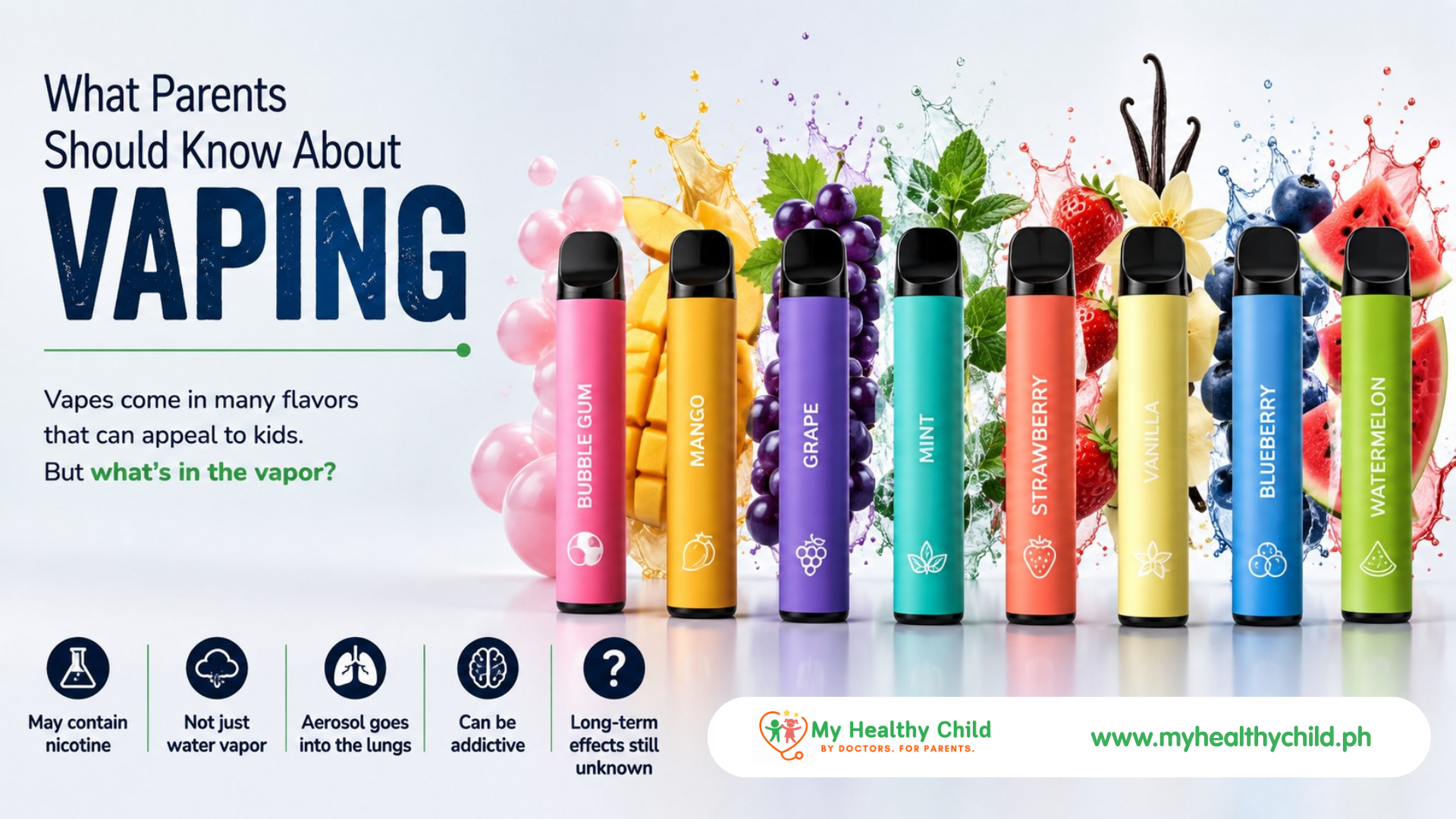
 Bubble gum. Cotton candy. Mango. Strawberry. Mint.
With sweet flavors and pleasant smells, vaping can seem very different from cigarette smoking. There may be no lingering smell of tobacco, and some vape products can even smell like candy or fruit.
For parents, that can create an important misconception:
If the vape smells harmless, is it indeed harmless?
The answer is no.
What comes out of a vape is not simply flavored water vapor. When a person vapes, the device heats a liquid and produces an aerosol—a mixture of tiny particles and chemicals that can be inhaled deep into the lungs.
For children and teenagers, whose lungs and brains are still developing, this is especially concerning.
What Is Actually Inside Vape Aerosol?
The contents vary depending on the device and vaping liquid, but vape aerosol may contain substances that you would not want your child breathing into their lungs.
These can include:
- Nicotine, a highly addictive substance found in many vaping products
- Ultrafine particles that can be inhaled deep into the lungs
- Volatile organic compounds (VOCs)
- Flavoring chemicals
- Heavy metals, such as nickel, tin, and lead, which may come from components of the device
The exact chemicals and their concentrations can vary considerably among products.
This is one reason why a pleasant smell should never be used as a measure of safety.
If some vape ingredients are used in food, doesn’t that mean they’re safe?
Not necessarily.
Some ingredients used in e-liquids, including propylene glycol, vegetable glycerin and certain flavoring substances, also have uses in food.
But there is an important difference between eating something and repeatedly inhaling it into the lungs.
A substance considered acceptable for use in food should not automatically be assumed to have the same safety profile when it is heated and inhaled.
This distinction is especially important when talking to children and teenagers who may think:
“If it tastes like candy, how harmful can it be?”
How something tastes or smells does not determine whether it is safe to inhale.
Why do vape flavors matter?
Flavor is one of the features that can make vaping particularly attractive to young people.
Fruit, candy, dessert and mint flavors can make vaping feel familiar and less threatening than conventional cigarettes.
There are thousands of distinct vape flavors worldwide, ranging from fruits and desserts to menthol and other specialty flavors.
But flavor changes the experience—not the fundamental fact that an aerosol is being inhaled into the lungs.
Sweet doesn’t mean safe.
A vape can smell like fruit or candy and still expose the person using it to nicotine and other potentially harmful substances.
Isn’t a vape cloud just water vapor?
No.
This is one of the most important vaping myths for parents and young people to understand.
What you see coming from an e-cigarette is an aerosol, not simply harmless steam.
An aerosol contains tiny particles and substances suspended in air. What is present can vary depending on the e-liquid, device, ingredients, heating coil and how the product is used.
Some chemicals can also be formed when the e-liquid is heated.
What happens when vape liquid is heated?
Heating matters.
The toxicity of e-cigarette aerosol can come from both the ingredients already present in the e-liquid and substances that can be produced when that liquid is heated by the device.
For example, heating propylene glycol and glycerol can generate carbonyl compounds, including substances such as formaldehyde, acetaldehyde and acrolein.
Acrolein is particularly concerning because it can irritate the airways and contribute to inflammatory and oxidative processes in respiratory tissues.
This is another reason why describing vaping as simply inhaling “flavored water vapor” is misleading.
What about vapes labeled “nicotine-free”?
A “nicotine-free” label does not automatically make a vape harmless.
Even without nicotine, vaping still involves heating a liquid and inhaling the resulting aerosol into the lungs.
The aerosol may contain flavoring substances, solvents, particles and other compounds.
So rather than asking only:
“Does this vape contain nicotine?”
Parents should also ask:
“What else is being heated and inhaled?”
Nicotine is an important concern—but it isn’t the only reason parents should take vaping seriously.
Can vaping harm the lungs?
The lungs are continuously exposed to whatever we breathe in.
Laboratory and animal studies have documented several potential effects of vaping exposure on the airways, including airway inflammation, oxidative stress, increased airway reactivity, changes in mucus secretion and effects on normal airway defense mechanisms.
Serious vaping-associated lung injuries have also been reported.
One example is EVALI—e-cigarette or vaping product use-associated lung injury—a severe pulmonary condition identified during a major outbreak beginning in 2019.
The outbreak was strongly associated with vitamin E acetate in certain THC-containing vaping products, although other substances and contaminants in e-liquids may also contribute to vaping-related lung injury.
The important message for families is not that every person who vapes will develop severe lung disease.
It is that vaping should not be considered harmless to the respiratory system.
But Isn’t Vaping Better Than Smoking Cigarettes?
Parents and teenagers sometimes hear that vaping is “safer than cigarettes.”
This can be misleading.
Conventional cigarette smoking is extremely harmful. Burning tobacco produces thousands of chemicals, including many toxic and cancer-causing substances. Cigarette smoke also contains tar and carbon monoxide, which are not typically found in vape aerosol.
Vaping does not involve tobacco combustion in the same way.
For adults who already smoke cigarettes, completely switching away from combustible cigarettes may reduce exposure to many smoking-related toxicants.
But:
Less harmful than cigarette smoking does not mean harmless.
And for children, teenagers and people who do not smoke, comparing vaping with cigarettes can create the wrong choice.
For a young person who doesn’t smoke, the question shouldn’t be:
“Should I smoke cigarettes or vape?”
It should be:
“Why start inhaling vape aerosol at all?”
For children and adolescents, the healthiest choice is not to start vaping.
How can I talk to my child about vaping?
You don’t have to wait until you find a vape in your child’s bag.
Everyday situations can provide opportunities to talk.
If your child sees someone vaping, encounters vape content online, or mentions that friends are vaping, ask what they know about it.
Try questions such as:
“What have you heard about vaping?”
“Why do you think some kids your age try it?”
“Do people at school think vaping is harmless?”
Listen before correcting misconceptions.
Then keep the science simple:
Sweet smell doesn’t mean safe.
Vape clouds aren’t simply water vapor.
Vaping can expose the lungs to nicotine and other potentially harmful substances.
A calm, factual conversation may make it easier for your child to ask questions—or to tell you if they have already experimented with vaping.
What parents should remember
A vape can look colorful.
It can smell fruity.
It can taste sweet.
But none of those things tells you whether what is being inhaled is safe.
The vape may smell like candy. But what your child breathes in is what matters.
For children and adolescents, the healthiest choice is not to start vaping.
References:
-
Mishra S, et al. Tobacco: Its historical, cultural, oral, and periodontal health association. J Int Soc Prev Community Dent. 2013;3(1):12–18. doi:10.4103/2231-0762.115708.
-
U.S. Department of Health and Human Services. E-Cigarette Use Among Youth and Young Adults: A Report of the Surgeon General. 2016.
-
Sassano MF, et al. Evaluation of e-liquid toxicity using an open-source high-throughput screening assay. PLoS Biol. 2018;16(3):e2003904. doi:10.1371/journal.pbio.2003904.
-
Bekki K, et al. Carbonyl compounds generated from electronic cigarettes. Int J Environ Res Public Health. 2014;11(11):11192–11200. doi:10.3390/ijerph111111192.
-
Hikisz P, et al. The tobacco smoke component acrolein: A major culprit in lung diseases and respiratory cancers. Cells. 2023;12(6):879. doi:10.3390/cells12060879.
-
Peterson LA, et al. Tobacco, e-cigarettes, and child health. Curr Opin Pediatr. 2017;29(2):225–230.
-
Smith MJ, Hilton S. Global regulatory approaches towards e-cigarettes: Key arguments and approaches pursued. IntechOpen. 2022. doi:10.5772/intechopen.107343.
-
Di Cicco M, et al. Potential effects of e-cigarettes and vaping on pediatric asthma. Minerva Pediatr. 2020;72(5):372–382. doi:10.23736/S0026-4946.20.05973-3.
-
Drummond MB, Upson D. Electronic cigarettes: Potential harms and benefits. Ann Am Thorac Soc. 2014;11(2):236–242.
-
Gordon T, et al. E-cigarette toxicology. Annu Rev Pharmacol Toxicol. 2022;62:301–322. doi:10.1146/annurev-pharmtox-042921-084202.
-
Soneji S, et al. Association between initial e-cigarette use and subsequent cigarette smoking among adolescents and young adults: A systematic review and meta-analysis. JAMA Pediatr. 2017;171(8):788–797.
-
Fernandez M, et al. Acute myocardial infarction with e-cigarette or vaping use in a young Filipino vape user. Respirol Case Rep. 2024.
-
Carey L, et al. Vaping-associated constrictive bronchiolitis. Respir Med Case Rep. 2024.
-
Jenssen BP, et al. E-cigarettes and similar devices. Pediatrics. 2019;143(2).
-
Landman ST, et al. Life-threatening bronchiolitis related to electronic cigarette use in a Canadian youth. CMAJ. 2019;191(48).
-
Serra C, et al. Prevalence and covariates of electronic cigarette use among students aged 13–15 years in the Philippines: 2019 Global Youth Tobacco Survey. Int J Environ Res Public Health. 2023;20:7193.
-
Lopez-Ojeda W, et al. Vaping and the brain: Effects of electronic cigarettes and e-liquid substances. J Neuropsychiatry Clin Neurosci. 2024;36(1).
-
Rebuli ME, et al. The e-cigarette or vaping product use-associated lung injury epidemic: Pathogenesis, management, and future directions. American Thoracic Society Workshop Report. 2022.
-
Deprato A, et al. Associations between vaping during pregnancy and perinatal outcomes: A systematic review and meta-analysis. J Hazard Mater. 2025;486:137028.
-
Lindson N, et al. Electronic cigarettes for smoking cessation. Cochrane Database Syst Rev. 2025.
-
Kundu A, et al. Evidence update on e-cigarette dependence: A systematic review and meta-analysis. Addict Behav. 2025;163:108243.