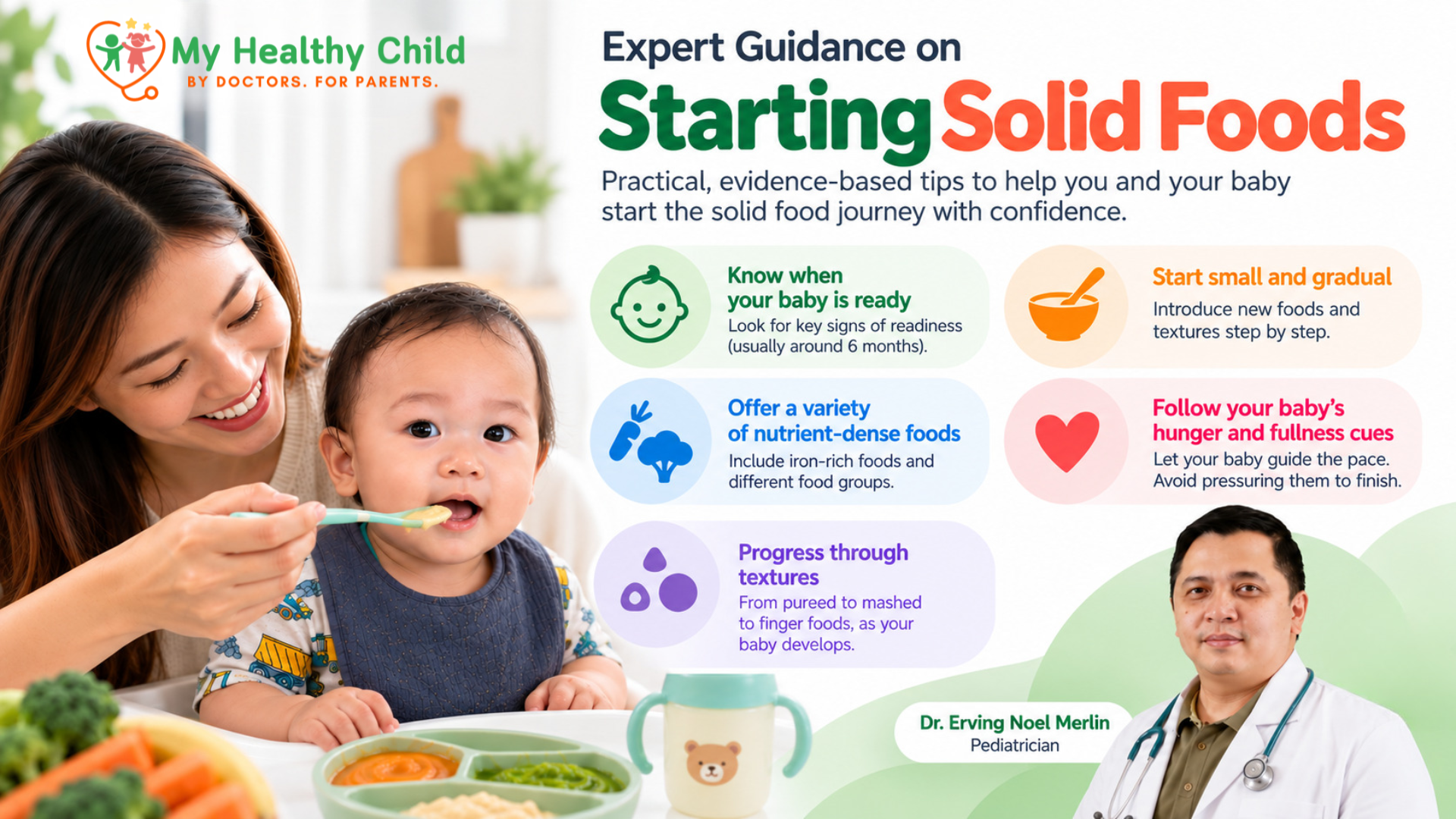
 Starting solid foods is one of the most exciting milestones in a baby’s first year. It can also bring plenty of questions for parents: When is my baby ready? How much should I give? Which foods should come first? What about choking? When can I introduce eggs or peanuts? And should I continue breastfeeding?
Complementary feeding is not about replacing breastmilk overnight. It is a gradual process of introducing safe, nutritious foods alongside milk feeds as your baby develops the skills and nutritional needs for them.
The World Health Organization (WHO) recommends beginning complementary foods at around 6 months of age. Continuing breastfeeding up to 2 years of age or beyond is preferred.
Here are 12 important things parents should know as their baby begins the journey from milk to family foods.
1. When Is Your Baby Ready for Solid Food?
Most babies are developmentally ready to begin complementary foods at around 6 months of age. WHO recommends complementary feeding beginning at 6 months, while allergy-prevention guidance also emphasizes developmental readiness and advises that solids should not be started before 4 months. Rather than relying on age alone, look at your baby’s overall development. Signs of readiness can include:
- Good head and neck control
- Ability to sit upright with some support
- Reaching for and grasping objects and bringing them toward the mouth
- Showing interest in food or watching others eat
- Opening the mouth when food is offered
These signs should be considered together. One behavior—such as watching you eat—doesn’t necessarily mean your baby is ready for complementary feeding.
If you are uncertain, talk with your pediatrician before starting.
2. Learn Your Baby’s Hunger and Fullness Cues
Feeding isn’t simply about getting your baby to finish a certain amount. Babies communicate hunger, interest and fullness through their behavior.
A hungry or interested baby might become excited when food is prepared, lean toward the caregiver or open their mouth when food is offered.
When your baby has had enough, they may turn their head away, lose interest, become distracted, push the spoon away or keep their mouth closed.
This approach is known as responsive feeding—recognizing and responding appropriately to your child’s hunger and fullness cues. WHO includes responsive feeding among its guiding principles for complementary feeding.
Remember that appetite naturally varies. A baby who enthusiastically eats one day may be less interested the next.
Avoid pressuring your baby to finish the bowl.
3. How Much Solid Food Should You Offer at First?
Think small and gradual.
Your baby’s first experience with solid food isn’t about eating a full meal. Your baby is learning entirely new skills: taking food from a spoon, moving it around the mouth, swallowing different textures and experiencing unfamiliar tastes.
Start with small amounts and gradually increase the quantity and frequency according to your baby’s age, appetite and development.
WHO recommends starting with small amounts at 6 months and gradually increasing as the child gets older. Its guidance generally recommends 2–3 complementary meals per day at 6–8 months, progressing to 3–4 meals per day at 9–23 months, with nutritious snacks added when appropriate.
Don’t worry if much of the first meal ends up on the bib rather than in your baby’s tummy. Learning to eat takes practice.
4. Progress Through Different Food Textures
Texture is an important part of learning to eat.
Babies can begin with foods that are appropriately pureed, mashed or semi-solid, then gradually progress to thicker and lumpier textures and developmentally appropriate finger foods.
WHO recommends gradually increasing the consistency and variety of foods as babies grow and develop. By around 8 months, many infants can manage suitable finger foods, and by around 12 months, most can eat many of the same types of foods as the family, provided they are prepared safely and appropriately.
You might progress through:
Pureed or finely mashed → roughly mashed → minced → chopped → appropriate finger and family foods
Always make sure the food’s size, shape and texture are appropriate for your baby’s developmental abilities.
5. What Foods Should You Offer?
There is no need for your baby’s diet to consist only of cereal or fruit puree.
As complementary feeding begins, offer a varied, nutrient-dense diet, with particular attention to foods that provide iron and other important nutrients.
Appropriate options can include:
- Iron-fortified infant cereals
- Meat and poultry prepared to an appropriate texture
- Fish, carefully checked for bones
- Well-cooked egg
- Cooked beans, lentils and other legumes
- Tofu
- Vegetables
- Fruits
- Grains
- Full-fat unsweetened yogurt and other appropriate dairy foods
WHO emphasizes dietary diversity and nutrient-dense foods, including animal-source foods, fruits, vegetables, nuts, pulses and seeds in safe, age-appropriate forms.
Your baby may not accept every new food immediately. Repeated exposure is part of learning to eat.
6. Reduce the Risk of Choking
Choking prevention should be part of every meal.
Babies and young children should always be appropriately seated and closely supervised while eating.
Avoid foods that are hard, round or otherwise difficult for your baby to manage safely. Whole nuts and large pieces of hard food, for example, can be choking hazards. Nuts can instead be offered in safe, age-appropriate forms such as smooth nut butter or finely ground nuts when appropriate.
Check fish carefully for bones and make sure meat and other foods are prepared in textures your baby can safely manage.
Parents and regular caregivers may also benefit from learning infant first aid and choking response.
7. Should You Continue Breastfeeding After Solid Foods?
Yes. Starting solids does not mean breastfeeding needs to stop.
At around 6 months, complementary foods are introduced because a baby’s nutritional needs begin to exceed what breastmilk alone can provide. Complementary foods are therefore added alongside breastfeeding, rather than immediately replacing it.
WHO recommends exclusive breastfeeding for the first 6 months, followed by nutritionally adequate and safe complementary foods. Breastfeeding is preferred to continue up to 2 years of age or beyond.
As your child grows, the balance between breastmilk and complementary foods gradually changes. This is a transition rather than an overnight switch.
8. Which Foods and Drinks Should Babies Avoid?
Knowing what not to give your baby is also important.
Honey
Do not give honey to babies younger than 12 months.
Honey can sometimes contain spores of Clostridium botulinum. In a young infant’s intestine, these spores can grow and produce a toxin capable of causing a rare but serious illness.
Whole nuts and other choking hazards
Do not give whole nuts to babies. When nuts are introduced, they should be provided in an age-appropriate form such as smooth nut butter/paste or finely ground nuts—not whole nuts or pieces.
Unpasteurized foods and drinks
Avoid unpasteurized milk and other foods that may expose young children to harmful microorganisms.
Sugary Drinks
Avoid sugar-sweetened beverages. WHO recommends that foods high in sugar, salt and trans fats should not be consumed by young children and that sugar-sweetened beverages should not be given.
Cow’s milk as the main drink
Cow’s milk may be used as an ingredient in foods when developmentally appropriate and tolerated, but it should not simply replace breastmilk or appropriate infant feeding as a baby’s main milk drink before 12 months.
Whenever possible, focus on nutritious, minimally processed foods without unnecessary added sugar or salt.
9. When and How Should Allergenic Foods Be Introduced?
Advice about allergenic foods has changed significantly over the years.
Parents were once commonly told to delay foods such as egg and peanut. Current evidence-based allergy guidance instead recommends introducing common allergenic foods during the first year of life, once the baby has started solids and is developmentally ready.
Common food allergens include:
- Egg
- Peanut
- Tree nuts
- Cow’s milk/dairy
- Wheat
- Soy
- Sesame
- Fish
- Shellfish
Well-cooked egg and peanut in a safe form—such as smooth peanut butter/paste or finely ground peanut—can be introduced soon after a developmentally ready baby has begun complementary foods. Never give whole peanuts or nuts to a baby.
Introduce new common allergens one at a time.
Introducing only one new common allergen at a meal makes it easier to identify the responsible food if your baby develops a reaction. Once an allergenic food has been introduced and tolerated, current allergy guidance recommends keeping it regularly in the child’s varied diet.
A caution for parents
If your baby has a known food allergy, severe eczema, or has previously reacted to a food, discuss introduction with your pediatrician or allergy specialist. A food to which a child is already known to be allergic should not be given unless specifically advised by the child’s healthcare professional.
10. What If Your Baby Has a Food Allergy?
A suspected food allergy should be properly assessed rather than diagnosed at home.
Food-allergic reactions can vary. Possible symptoms may involve the skin, gastrointestinal tract or breathing, and reactions can sometimes become severe.
If you suspect that your baby has reacted to a food:
Stop giving the suspected food and seek medical advice.
Your pediatrician may recommend evaluation by an allergist or other appropriate specialist.
If an allergy is confirmed, parents need an individualized plan that covers avoiding the trigger, reading food labels, preventing accidental exposure and maintaining an age-appropriate, nutritionally balanced diet.
Difficulty breathing, swelling of the tongue or throat, collapse, or other signs of a severe allergic reaction require emergency medical attention.
11. How Can You Tell If Your Baby Is Getting Enough Nutrition?
Parents naturally focus on how many spoonfuls their baby eats, but one meal—or even one day—is not the best measure of nutritional adequacy.
Look at your child’s overall pattern.
Your pediatrician will consider factors such as:
- Growth and weight gain over time
- Development
- Feeding pattern and dietary variety
- Hydration and urine output
- Your baby’s general alertness and well-being
Regular well-child visits allow your pediatrician to monitor your child’s growth and discuss any feeding or nutritional concerns.
If your baby consistently refuses food, appears to have difficulty swallowing, is not progressing with textures, has feeding-related coughing or choking, or you are concerned about growth, seek medical advice.
12. Five Principles for a Smoother Solids Journey
Introducing solids doesn’t need to become a daily battle.
Go at your baby’s pace. Babies develop feeding skills at different rates.
Offer variety. Introduce different nutritious foods, tastes and appropriate textures.
Keep mealtimes positive. Respond to hunger and fullness cues rather than forcing another spoonful.
Lead by example. As your baby moves toward family foods, eating together can help make mealtimes a normal and enjoyable part of family life.
Be patient and consistent. Rejecting broccoli today doesn’t mean your child will never eat broccoli. Familiarity develops through repeated, pressure-free exposure.
And celebrate the small wins. Touching an unfamiliar food, tasting it, learning to chew a new texture and eventually eating family meals are all part of the journey.
From Baby’s First Spoonful to Family Meals
Complementary feeding is much more than simply adding solid food to your baby’s diet.
Between about 6 and 24 months, children are developing feeding skills, experiencing new tastes and textures and establishing dietary patterns that can extend beyond infancy. WHO describes this as an important developmental period and a time when adequate nutrition is particularly important for healthy growth.
There is no need to create a “perfect eater.”
Instead, focus on providing safe, nutritious and varied foods; progressing textures appropriately; responding to your baby’s hunger and fullness cues; introducing common allergens appropriately; and making mealtimes a positive experience.
And throughout this transition, remember:
Breastmilk remains important. Continued breastfeeding up to 2 years of age or beyond is recommended while appropriate complementary foods are introduced from around 6 months.
When you have concerns about your baby’s feeding, growth, allergies or development, speak with your pediatrician. Individual children may require recommendations that differ from general feeding guidance.
References
World Health Organization. Guideline for complementary feeding of infants and young children 6–23 months of age. 2023. WHO Complementary Feeding Guideline
World Health Organization. Infant and young child feeding. WHO Infant and Young Child Feeding Guidance
World Health Organization. Complementary feeding. WHO Complementary Feeding Overview
World Health Organization. Breastfeeding. WHO Breastfeeding Guidance
Australasian Society of Clinical Immunology and Allergy. Infant Feeding for Food Allergy Prevention—Summary of Recommendations. Updated 2026. ASCIA Infant Feeding and Allergy Prevention Guideline
Australasian Society of Clinical Immunology and Allergy. How to Introduce Solid Foods to Babies for Allergy Prevention. ASCIA Allergy Prevention Guidance for Parents