 You may already know that children should not vape.
But what if someone else is vaping around them?
A family member may vape inside the house. Someone may vape in the car. Or a child may spend time in a room where vaping regularly takes place.
Because vape aerosol can disappear quickly and may smell sweet or pleasant, it can be easy to assume that once the cloud is gone, so is the exposure.
But there are two other ways parents should think about vaping exposure: secondhand and thirdhand exposure.
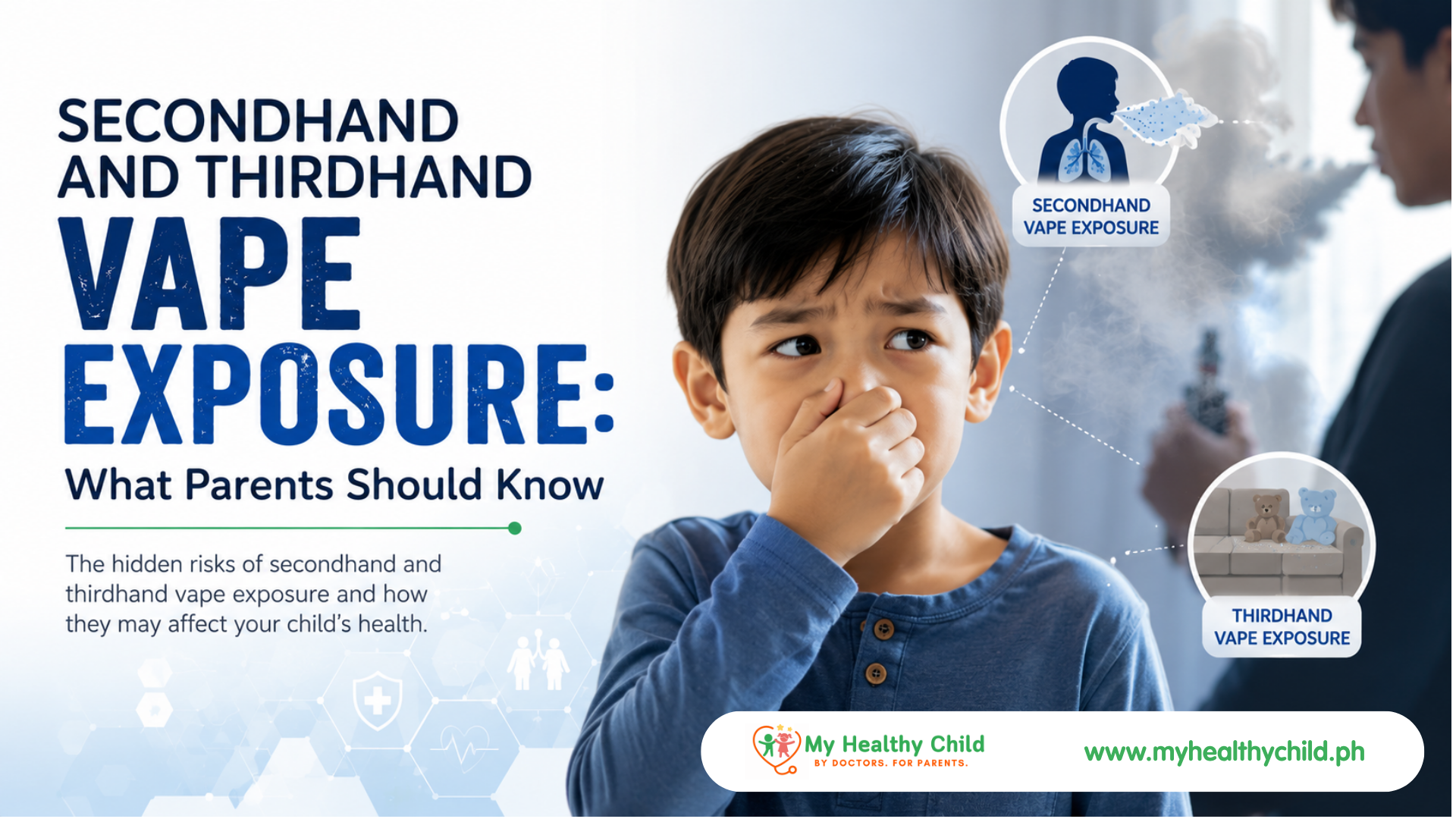
What is secondhand vape exposure?
When someone uses an e-cigarette or vape, they breathe out an aerosol into the surrounding air.
People nearby can then breathe in some of that aerosol.
This is called secondhand exposure.
And unlike what is sometimes assumed, vape aerosol is not simply harmless water vapor. Depending on the product, it can contain substances including nicotine, ultrafine particles, volatile organic compounds and metals, among other chemicals.
Your child doesn’t have to be the one vaping to be exposed.
That is an important message for every household.
Why are children a particular concern?
Children are still growing and developing.
They also breathe more air relative to their body size than adults and may spend significant amounts of time indoors—at home, in cars and in other enclosed spaces.
This makes keeping the air around children as free as possible from tobacco smoke and vape aerosol a sensible precaution.
For parents, the practical message is straightforward:
Don’t vape around children.
What is thirdhand exposure?
There is another type of exposure that parents may be less familiar with.
After smoking or vaping takes place, some substances can settle onto surrounding surfaces and materials.
This is commonly described as thirdhand exposure.
Residue may be deposited on surfaces and materials such as:
clothing, furniture, floors, walls and other household surfaces.
This is especially relevant when thinking about young children, who frequently touch surfaces and then put their hands or objects into their mouths.
If I can’t see or smell anything, is the room safe?
Not necessarily.
Smell is not a reliable way to determine whether potentially harmful substances are present.
A room can stop smelling like vape flavoring relatively quickly, but that does not necessarily tell you whether aerosol particles or residues have completely disappeared.
This is one reason why “I only vape when the child isn’t in the room” may not be the best approach.
Avoiding vaping inside the home or car provides a clearer way to reduce exposure.
What about vaping near an open window?
Opening a window may improve ventilation, but it does not guarantee that other people will not be exposed.
Similarly, vaping in another part of the room, using a fan, or trying to blow the aerosol away from a child should not be considered equivalent to maintaining a vape-free environment.
The simplest rule is: keep homes and cars smoke- and vape-free.
That protects not only children but everyone who shares those spaces.
What about thirdhand cigarette smoke?
The same principle is particularly important with cigarette smoking.
Tobacco smoke contains numerous toxic and cancer-causing substances. Residues from smoking can remain on indoor surfaces, fabrics and dust after a cigarette has been extinguished.
This is why protecting children from tobacco exposure means thinking beyond whether someone is actively smoking in front of them.
Where smoking happens matters, too.
“But vaping is different from cigarette smoke.”
Yes. Cigarette smoke and vape aerosol are not identical, and they should not be presented as though they carry exactly the same risks.
Burning tobacco produces a particularly harmful mixture of toxic and cancer-causing chemicals.
However, the fact that vape aerosol is different from cigarette smoke does not make it harmless.
For a child who neither smokes nor vapes, avoiding unnecessary exposure to both tobacco smoke and vape aerosol is the appropriate goal.
How can parents reduce exposure at home?
You don’t need complicated rules.
Make your home and car smoke- and vape-free spaces.
If relatives, visitors, caregivers or household members smoke or vape, explain that the rule is about protecting the child’s environment—not judging the person using the product.
And remember that children learn from what they see.
Creating a smoke- and vape-free home doesn’t only reduce exposure. It also helps establish what is normal in your family:
Clean air. No smoking. No vaping around children.
What Parents Should Remember
Your child does not need to hold a vape or cigarette to be exposed to substances released by them.
Secondhand exposure can occur when someone nearby breathes in smoke or vape aerosol.
Thirdhand exposure refers to residues that can remain on surfaces and materials after smoking or vaping has occurred.
The best protection is a smoke- and vape-free home and car.
Protecting your child’s lungs starts with protecting the air and environment around them.
References:
- U.S. Department of Health and Human Services. E-Cigarette Use Among Youth and Young Adults: A Report of the Surgeon General. 2016.
- Peterson LA, et al. Tobacco, E-Cigarettes, and Child Health.Curr Opin Pediatr. 2017;29(2):225–230.
- Gordon T, et al. E-Cigarette Toxicology.Annu Rev Pharmacol Toxicol. 2022;62:301–322.
- Bekki K, et al. Carbonyl Compounds Generated from Electronic Cigarettes.Int J Environ Res Public Health. 2014;11:11192–11200.
- Sassano MF, et al. Evaluation of E-liquid Toxicity.PLoS Biol. 2018;16:e2003904.
- Di Cicco M, et al. Potential Effects of E-Cigarette and Vaping on Pediatric Asthma.Minerva Pediatr. 2020;72:372–382.