
How Do I Know If I’m Really in Labor, And What Happens Next?
Learn the true signs of labor, how your body progresses through birth, and when it’s time to go to the hospital.

At a Glance
- Labor starts with consistent, intensifying contractions — not just cramps.
- Real labor doesn’t stop with rest or hydration.
- The stages of labor follow a progression — knowing them helps you decide when to go.
Early Signs: What’s Normal, What’s Not Yet Labor
In the final weeks of pregnancy, you may feel:
- Braxton-Hicks contractions (irregular, mild, and stop with movement or hydration)
- Lightening (baby drops lower into the pelvis)
- Loose stools or increased vaginal discharge
- Nesting energy or fatigue
These signs don’t mean labor has started — just that your body is preparing. Keep monitoring.
Real Labor: What to Watch For
Labor typically begins with:
- Rhythmic contractions that come every 5–10 minutes, last 30–70 seconds, and get stronger and closer over time
- Bloody show — mucus tinged with blood
- Back pain or pressure that doesn’t go away with position changes
- Water breaking — either a gush or steady trickle (may be odorless and clear or pale yellow)
A good rule: if contractions are less than 5 minutes apart for at least an hour, and you can’t talk through them — labor is likely active.
If your bag of waters breaks, go to the hospital even without contractions—especially if the fluid is green, foul-smelling, or if you’ve tested positive for Group B strep (a common vaginal bacteria that can be harmful to newborns during delivery).
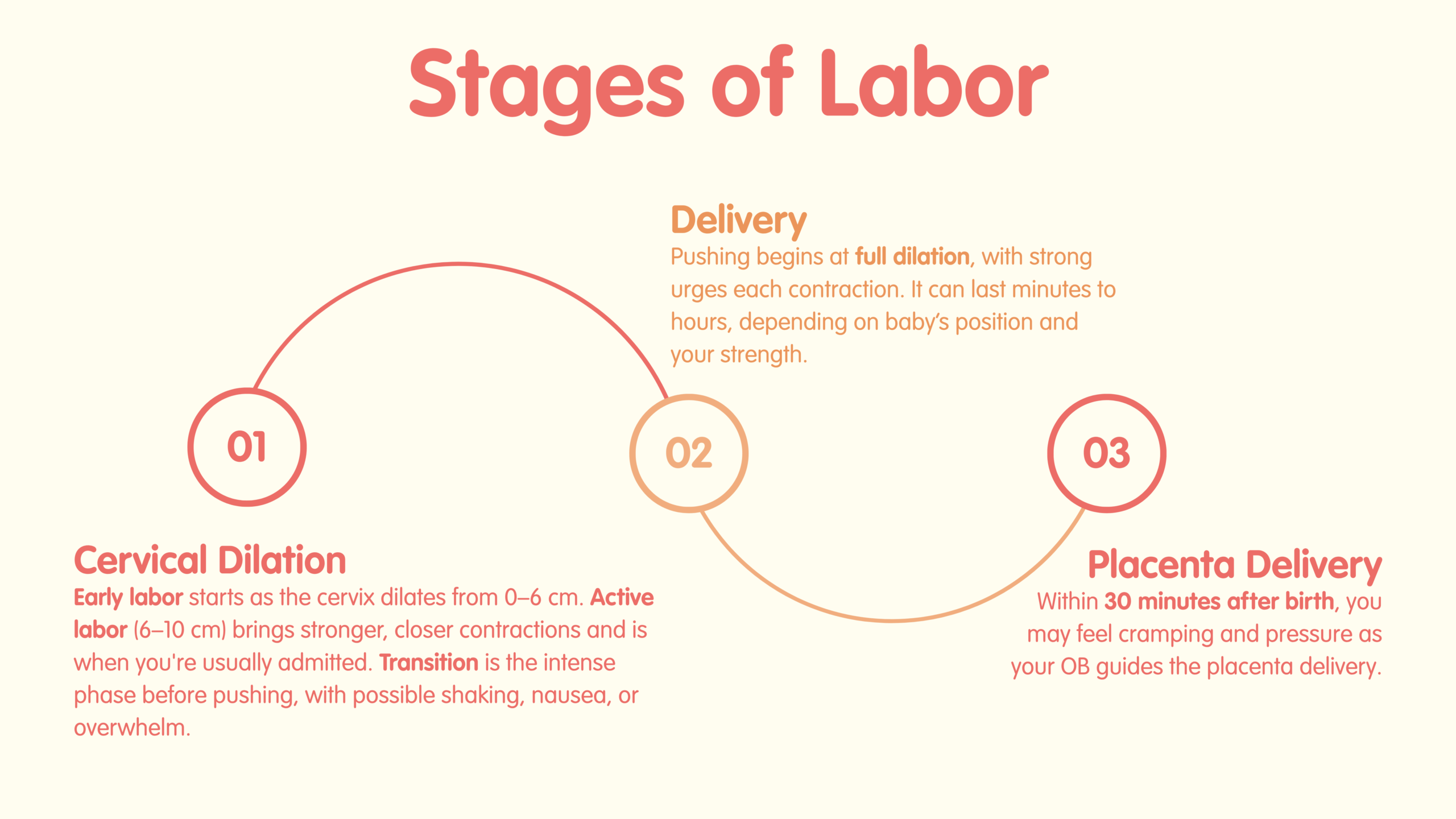
Stages of Labor: What Happens as It Progresses
Stage 1: Cervical Dilation
- Early labor: cervix thins and dilates from 0–6 cm; contractions are manageable.
- Active labor: 6–10 cm; contractions become stronger, longer, and closer. You’ll usually be admitted around this phase.
- Transition: final part before pushing; may involve shaking, nausea, or emotional overwhelm.
Stage 2: Delivery
- Begins when cervix is fully dilated.
- You’ll feel a strong urge to push with each contraction.
- May last minutes or hours depending on baby’s position and maternal strength.
Stage 3: Placenta Delivery
- Happens within 30 minutes after birth.
- You may feel cramping and pressure; your OB will help guide the process.
What to Do Next: Guidance for Pregnant Moms
- Call your OB or go to the hospital if contractions are regular, painful, and increasing — especially if your water has broken.
- Keep a timer or app handy to track intervals — don’t rely on guesswork once contractions begin.
- If you’re unsure, go in for a labor check — it’s better to be sent home than to arrive too late.
Note:
This article was medically reviewed and written in collaboration with doctors and medical professionals committed to providing pediatric health education.
References:
World Health Organization (WHO) – Maternal and Perinatal Health
American College of Obstetricians and Gynecologists (ACOG)
Centers for Disease Control and Prevention (CDC – U.S.) – Pregnancy

Marie Victoria S. Cruz-Javier, MD, FPOGS, FPSGE
Obstetrics and Gynecology Minimally Invasive Gynecologic Surgery and Robotic Surgery Aesthetic Gynecology
Disclaimer:
The information in this article is intended for educational purposes only and does not substitute professional medical advice, diagnosis, or treatment. Always consult your physician, pediatrician, or qualified healthcare provider with any questions you may have regarding a medical condition or health objectives.