
How Can I Track Development When My Child Has Delays?
A guide to understanding your child’s pace, recognizing real progress, and staying involved in their daily growth

At a Glance
- Developmental progress isn’t always a straight line, but it leaves clues.
- Focus on function gains, not just textbook milestones.
- Small, steady changes count—and you’re part of the picture.
Look Beyond Standard Milestone Charts
If your child has delays or a diagnosis, typical milestone charts can feel irrelevant or discouraging. Instead, developmental tracking should focus on:
- How your child uses skills in real life
- Whether they respond to therapy and routines
- Functional change over time, not just age-based checklists
Doctors monitor growth across four areas: communication, motor skills, social-emotional behavior, and daily living skills.
Signs of Real-Life Progress
- Communication
Progress can include more gestures, new sounds, eye contact, or using an Augmentative and Alternative Communication (AAC) device (ex. Picture boards or visual cards, speech-generating devices or similar apps). Even small attempts at interaction matter. - Motor Skills
We look at both gross (sitting, crawling, walking) and fine motor (grasping, stacking, feeding). Progress means better coordination, new attempts, or longer stamina—not perfection. - Social and Emotional Growth
Signs may include more turn-taking, reduced meltdowns, recognizing familiar people, or joining shared play—even briefly. - Daily Living Skills
Dressing, feeding, brushing teeth, or tolerating new foods all count. Participation—even partial—means growing independence.
When to Reassess or Speak Up
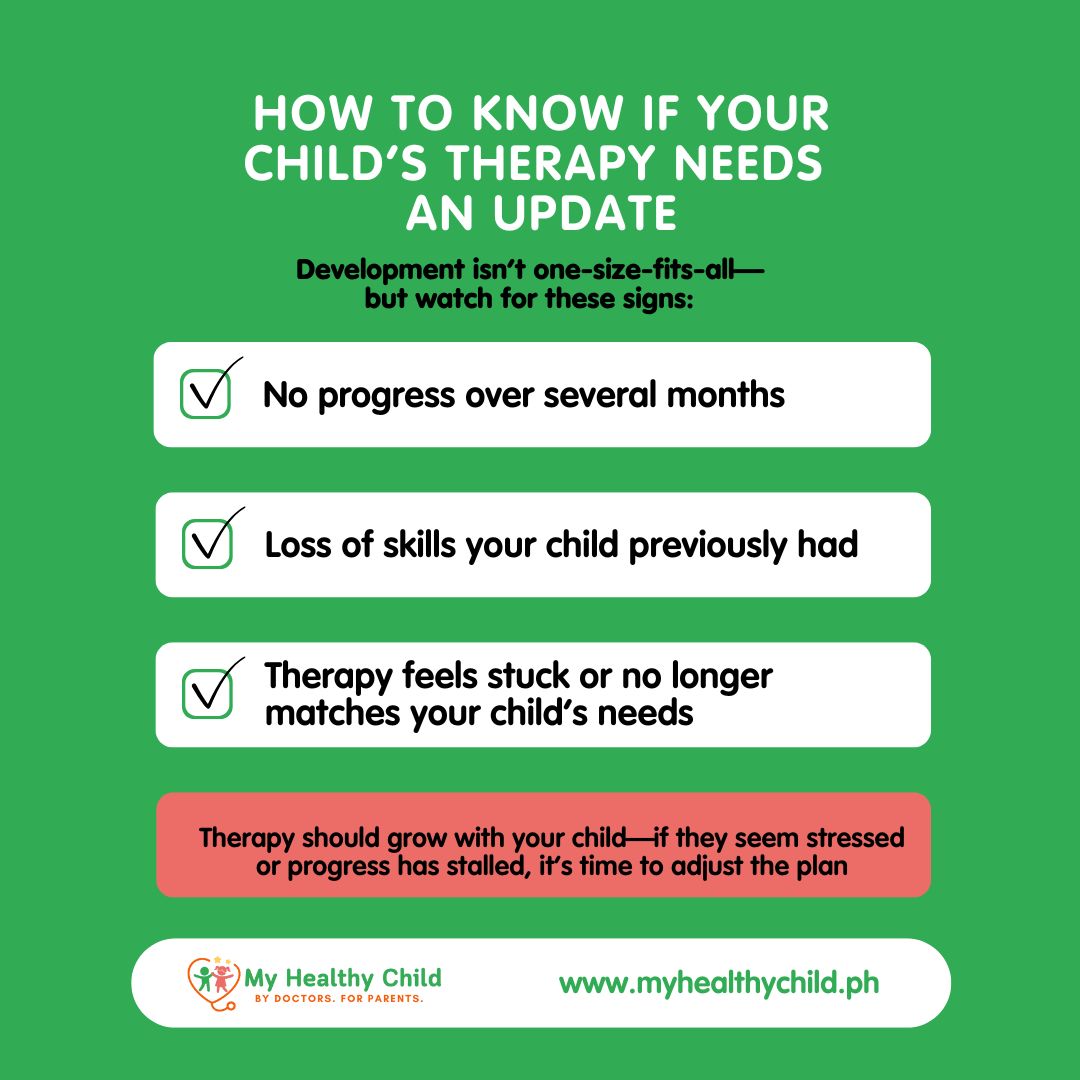
Development doesn’t move at a fixed pace—but watch for:
- No gains over several months
- Regression in skills your child previously had
- Sessions that feel stuck or no longer relevant
Therapy plans should evolve.
If progress has stalled or your child seems stressed, it’s time to update the approach.
What to Do Next: Guidance for Parents
- Track weekly wins. Even tiny changes in words, movement, or mood help shape better care plans.
- Ask early. If you’re unsure, don’t wait for a formal diagnosis to seek help.
- Speak up if you feel stuck. Progress isn’t always fast—but it shouldn’t feel frozen.
Note:
This article was medically reviewed and written in collaboration with doctors and medical professionals committed to providing pediatric developmental health education.
References:
U.S. Centers for Disease Control and Prevention (CDC)
CHADD (Children and Adults with Attention-Deficit/Hyperactivity Disorder)

Francis Xavier M. Dimalanta, MD, FPPS, FPSDBP
Developmental and Behavioral Pediatrician
Fellow, Philippine Pediatric Society
Fellow, Philippine Society for Developmental and Behavioral Pediatrics
Head, Section of Developmental and Behavioral Pediatrics
Institute of Pediatrics and Child Health
St Luke’s Medical Center - Quezon City and Global City
Medical Director, A Child’s DREAM Foundation, Inc (est. 2003)
Disclaimer:
The information in this article is intended for educational purposes only and does not substitute professional medical advice, diagnosis, or treatment. Always consult your physician, pediatrician, or qualified healthcare provider with any questions you may have regarding a medical condition or health objectives.