
How Can I Support My Child’s Therapy at Home?
Using daily routines to build on therapy goals in speech, motor skills, and emotional regulation

At a Glance
- Home routines offer powerful moments to reinforce therapy goals.
- Skills grow through practice in real settings—not just in clinics.
- Focus on consistency, not perfection.
Why Home Routines Matter
Therapy may happen once or twice a week—but learning happens all the time. When a child practices skills during everyday activities, the brain forms stronger, lasting connections. This is called generalization.
You don’t need to be a therapist. Just embedding simple actions—during meals, play, or bedtime—can support gains in speech, motor skills, and self-regulation.
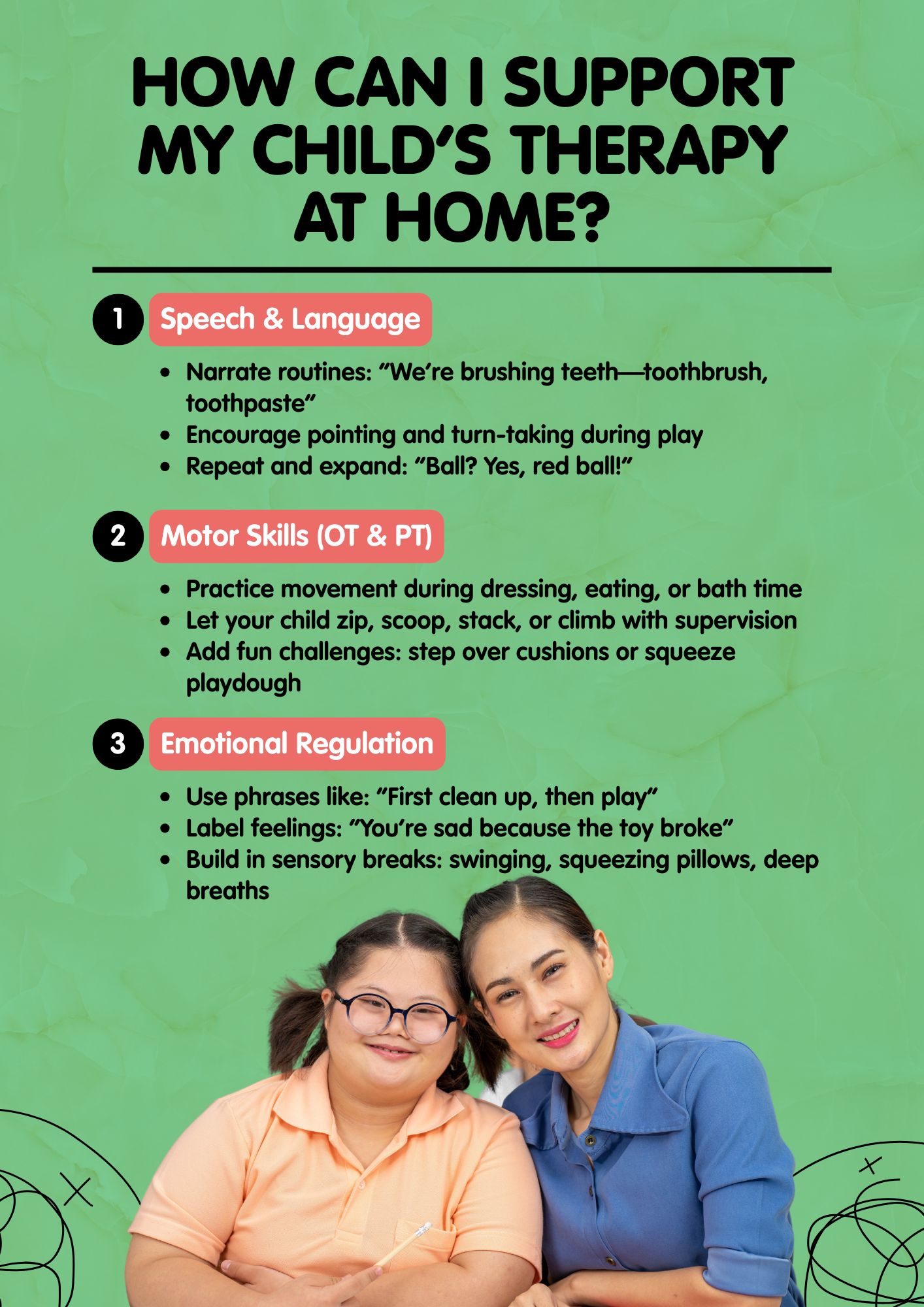
What Therapy Practice Looks Like in Daily Life
Speech and Language
- Narrate daily actions: “We’re brushing teeth. Toothbrush, toothpaste.”
- Encourage turn-taking and pointing during play.
- Repeat and expand your child’s words: “Ball? Yes, red ball!”
Motor Skills (OT + PT)
- Use dressing, feeding, and bath time to work on hand control, balance, or movement.
- Let your child zip, stack, scoop, or climb with supervision.
- Add mini-challenges like stepping over cushions or squeezing playdough.
Emotional Regulation
- Use predictable phrases: “First clean up, then we play.”
- Label feelings: “You’re sad because the toy broke.”
- Build in short sensory breaks (e.g., swinging, squeezing a pillow, deep breathing)
These daily moments help therapy “stick” by linking new skills with real experiences.
Making It Doable for Your Family
- Pick 1–2 focus skills and work them into one daily routine
- Keep it light—no drills or pressure
- Use the same language or cues across all caregivers
- If resistance shows up, pause and try again later
Therapists can offer simple at-home ideas tailored to your child’s current goals.
What to Do Next: Guidance for Parents
- Choose one routine (like dressing or brushing teeth) and build in one therapy skill this week.
- Ask your therapist for a weekly home strategy that fits naturally into your day.
- Celebrate effort, not just success. Consistent practice leads to long-term gains.
Note:
This article was medically reviewed and written in collaboration with doctors and medical professionals committed to providing pediatric developmental health education.
References:
U.S. Centers for Disease Control and Prevention (CDC)
CHADD (Children and Adults with Attention-Deficit/Hyperactivity Disorder)

Francis Xavier M. Dimalanta, MD, FPPS, FPSDBP
Developmental and Behavioral Pediatrician
Fellow, Philippine Pediatric Society
Fellow, Philippine Society for Developmental and Behavioral Pediatrics
Head, Section of Developmental and Behavioral Pediatrics
Institute of Pediatrics and Child Health
St Luke’s Medical Center - Quezon City and Global City
Medical Director, A Child’s DREAM Foundation, Inc (est. 2003)
Disclaimer:
The information in this article is intended for educational purposes only and does not substitute professional medical advice, diagnosis, or treatment. Always consult your physician, pediatrician, or qualified healthcare provider with any questions you may have regarding a medical condition or health objectives.