
How Can I Support My Baby’s Brain While Still Pregnant?
Discover how nutrients, sleep, stress, and environment all shape your baby’s brain — and how to make every day count.

At a Glance
- Your baby’s brain forms in layers — from structure to memory to emotion.
- DHA, choline, iron, and iodine are the key nutrients for brain development.
- Sleep, calm, and connection matter as much as supplements.
Brain Development Starts Early — and Never Pauses
By the 4th week of pregnancy, the fetal brain and spinal cord are already forming. In the second trimester, the cerebral cortex begins to organize. By the third trimester, neurons are firing, myelination begins, and your baby starts recognizing sound, light, and even your voice.
Each stage of development depends on specific nutrients and hormones, and is vulnerable to both deficiency and excess stress. What you eat, how you rest, and how you cope all influence long-term brain wiring.
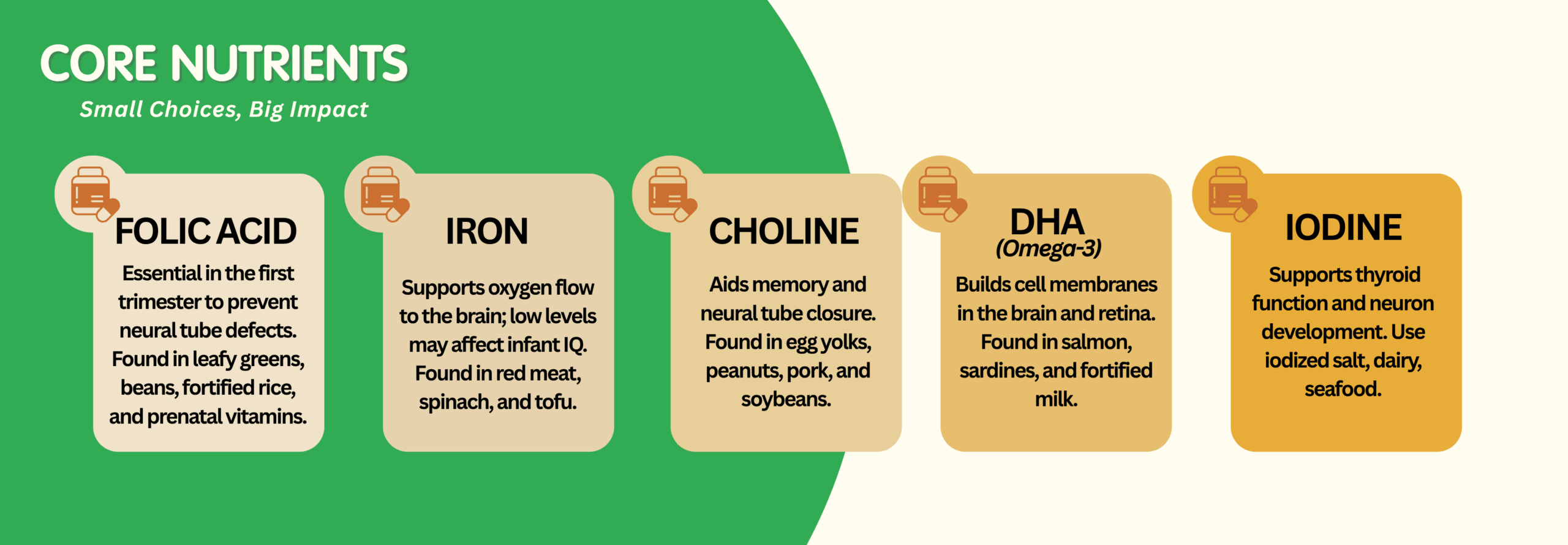
The Core Nutrients: Timing Matters
- Folic acid — Most critical in the first trimester to prevent neural tube defects. Found in leafy greens, beans, fortified rice, and prenatal vitamins.
- Iron — Needed for oxygen delivery to brain cells. Low iron in pregnancy is linked to lower infant IQ. Best sources: red meat, spinach, tofu.
- Choline — Supports memory and neural tube closure. Found in egg yolks, peanuts, pork, and soybeans. Most prenatal vitamins don’t include Choline, so ask your doctor if you need a separate supplement.
- DHA (omega-3) — Builds cell membranes in the brain and retina. Found in salmon, sardines, and fortified milk.
- Iodine — Supports thyroid function and neuron development. Use iodized salt, dairy, seafood.
These nutrients build the brain’s structure, memory centers, and communication signals. Deficiencies don’t always show symptoms — that’s why intentional eating and supplements are key.
Sleep, Calm, and Cortisol Control
Maternal sleep and mental health directly affect fetal brain wiring. Chronic stress raises cortisol, which may disrupt brain growth, particularly in the amygdala (emotion regulation) and hippocampus (memory formation).
- Sleep 7–9 hours to allow hormone regulation and fetal growth.
- Practice calm breathing, especially during transitions and bedtime.
- Social support and regular connection with others reduce stress-driven inflammation.
Studies show that babies born to mothers with stable sleep and low stress during pregnancy have better self-regulation, attention, and learning markers in infancy and childhood.
What to Do Next: Guidance for Pregnant Moms
- Include choline-rich foods daily — most prenatal vitamins don’t cover your full need.
- Avoid excessive multitasking — protect sleep and quiet time as brain-building activities.
- If you feel overwhelmed or can’t rest, ask your OB about safe mental health support options
during pregnancy.
Note:
This article was medically reviewed and written in collaboration with doctors and medical professionals committed to providing pediatric health education.
References:
World Health Organization (WHO) – Maternal and Perinatal Health
American College of Obstetricians and Gynecologists (ACOG)
Centers for Disease Control and Prevention (CDC – U.S.) – Pregnancy

Marie Victoria S. Cruz-Javier, MD, FPOGS, FPSGE
Obstetrics and Gynecology Minimally Invasive Gynecologic Surgery and Robotic Surgery Aesthetic Gynecology
Disclaimer:
The information in this article is intended for educational purposes only and does not substitute professional medical advice, diagnosis, or treatment. Always consult your physician, pediatrician, or qualified healthcare provider with any questions you may have regarding a medical condition or health objectives.