
Am I Eating the Right Foods for My Baby’s Development?
Understand which nutrients matter most in each trimester, and how daily choices shape your baby’s brain, body, and future health.
Eating well is one of the best things you can do during pregnancy. Good nutrition helps you
handle the extra demands on your body as your pregnancy progresses. The goal is to balance
getting enough nutrients to support the growth of your fetus and maintaining a healthy weight.
At a Glance
- Your baby’s organs, brain, and immune system are shaped by what you eat — and when.
- Each trimester has critical nutrients: folate and iron early, choline and DHA later.
- Food-first still matters. Supplements support, but real meals build your baby’s body.
First Trimester: Lay the Foundation
This is when the brain, spinal cord, and vital organs begin forming — often before you even know you’re pregnant.
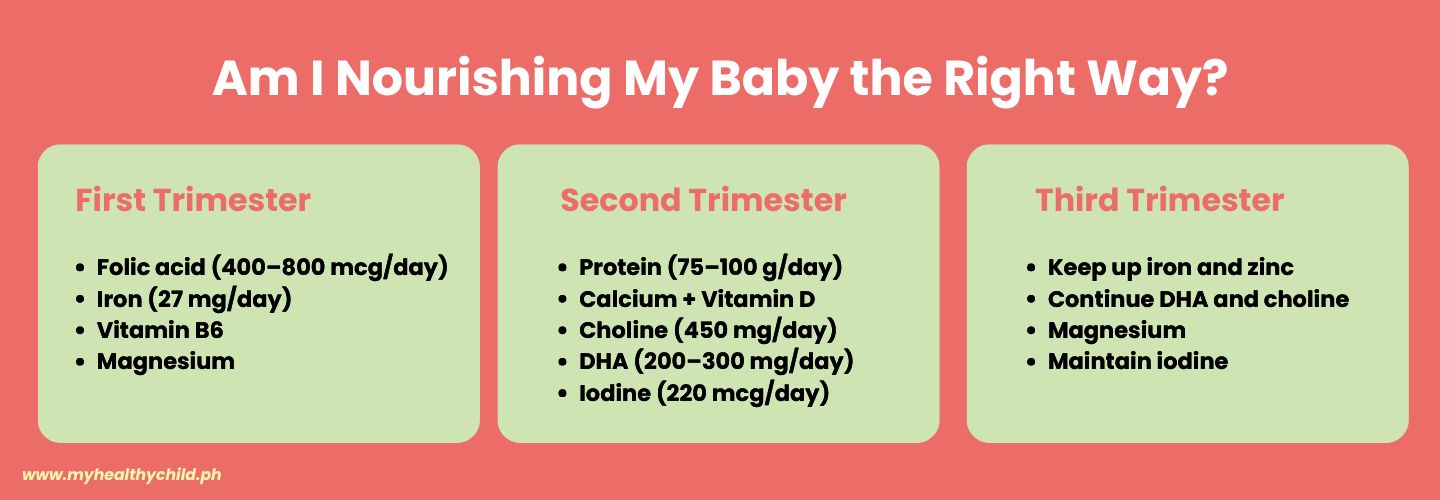
- Folic acid (400–800 mcg/day) prevents neural tube defects. Found in leafy greens, malunggay, monggo, and fortified cereals.
- Vitamin B6 helps ease nausea and regulate mood (bananas, whole grains, chicken).
Second & Third Trimester:
Building Growth and Structure to Final Brain Wiring Your baby is now expanding rapidly — building bones, organs, and early brain pathways.
- Protein (75–100 g/day) fuels organ and muscle growth (tofu, eggs, fish, lean meat).
- Calcium + Vitamin D help bone formation and maternal nerve function. Look to dairy, sardines, fortified soy milk, and sun exposure.
- Choline (450 mg/day) supports brain memory center development. Found in egg yolks, peanuts, pork, and soy.
- DHA (200–300 mg/day) strengthens vision and brain wiring. Choose salmon, milkfish, sardines.
- Iodine (220 mcg/day) is critical for metabolism and brain function — best from iodized salt, seafood, and dairy.
- Iron (27 mg/day) supports blood cell formation and oxygen delivery. Combine with vitamin C (like calamansi) for better absorption.
Digestion, Gut Health, and Nutrient Timing
- Fiber from papaya, guava, and greens prevents constipation and supports stable blood sugar.
- Probiotics (yogurt, fermented vegetables) strengthen the maternal and fetal microbiome.
- Water intake (8–12 cups equivalent to 64-96 ounces per day) improves nutrient delivery and
reduces bloating. - Smart pairings: Take iron with vitamin C, not with calcium. Add healthy fat (avocado, plant oil) to help absorb vitamins A, D, E, and K.
What to Avoid
- Raw or undercooked meat, sushi, and unpasteurized cheese — risk of listeria and parasites.
- Pregnant women up to 8 to 12 ounces of fish weekly, but no more than 6 ounces of albacore or “white” tuna. Because nearly all fish and shell-fish contain trace amounts of mercury, pregnant and lactating women are advised to avoid specific types of fish with potentially high
methyl/mercury levels, such as shark, swordfish, king mackerel, and tile fish. If the mercury
content of locally caught fish is unknown, limit overall fish consumption to 6 ounces per week. - Alcohol and nicotine — both reduce oxygen and blood supply to the fetus.
- No more than 200 mg. caffeine per day, equivalent to a 12 oz. brewed coffee, is safe. Fetal
growth restriction occurs when the intake exceeds 500 mg or 5 cups. - If you intend to use herbal supplements, it is advisable to consult with your OB.
What to Do Next: Guidance for Pregnant Moms
- Ask your OB about adding DHA supplements if you don’t have them in your prenatal. Choline
can come from your diet, but most prenatal supplements don’t include it. - Use trimester-specific grocery lists to build intentional meals, not just eat more.
- Call your doctor if you’re losing weight, have persistent vomiting, or aren’t able to eat balanced meals.
Note:
This article was medically reviewed and written in collaboration with doctors and medical professionals committed to providing pediatric health education.
References:
World Health Organization (WHO) – Maternal and Perinatal Health
American College of Obstetricians and Gynecologists (ACOG)
Centers for Disease Control and Prevention (CDC – U.S.) – Pregnancy
Cunningham, F., Leveno, K. J., et al. Williams Obstetrics, 26 th ed. McGraw Hill, 2022

Marie Victoria S. Cruz-Javier, MD, FPOGS, FPSGE
Obstetrics and Gynecology Minimally Invasive Gynecologic Surgery and Robotic Surgery Aesthetic Gynecology
Disclaimer:
The information in this article is intended for educational purposes only and does not substitute professional medical advice, diagnosis, or treatment. Always consult your physician, pediatrician, or qualified healthcare provider with any questions you may have regarding a medical condition or health objectives.