 Cigarettes. Vapes. Heated tobacco products. Hookahs.
They may look different, smell different, and be marketed or perceived differently. But for parents, there is an important principle to remember:
There is no harmless way for a child or teenager to smoke or vape.
Cigarette smoking exposes the body to thousands of chemicals produced when tobacco burns, including substances known to cause cancer.
Vaping does not burn tobacco in the same way—but that does not make vaping harmless.
For children and adolescents who do not smoke, the healthiest choice is simple:
Don’t start smoking. Don’t start vaping.
Why is cigarette smoking so harmful?
When tobacco burns, it produces smoke containing a complex mixture of chemicals.
Cigarette smoking is strongly associated with serious diseases affecting the lungs, heart and blood vessels, as well as many types of cancer.
It can also lead to nicotine dependence, making it difficult for a person to stop even when they want to.
The health risks of cigarette smoking are well established. But the emergence of newer nicotine products has created another question for families:
Does “different from cigarettes” mean safe?
Is vaping safe because there is no tobacco smoke?
No.
A vape heats a liquid to create an aerosol that the user inhales. That aerosol is not simply water vapor.
Depending on the product, vape aerosol can expose users to nicotine and other potentially harmful substances.
As discussed throughout this MyHealthyChild series, sweet flavors and pleasant smells can make vaping seem less threatening than cigarette smoking.
But how something smells or tastes does not determine whether it is safe to inhale.
Different does not mean harmless.
But isn’t vaping less harmful than cigarette smoking?
This is where parents need an important distinction.
Cigarette smoking and vaping should not be presented as though they carry exactly the same level of risk.
Burning tobacco produces a particularly harmful mixture of toxic and cancer-causing substances. For an adult who already smokes cigarettes, completely switching away from combustible cigarettes may reduce exposure to many smoking-related toxicants.
But this does not mean vaping is healthy or safe.
And for a child, teenager, or nonsmoker, comparing vaping with cigarettes can create the wrong question.
Instead of asking:
“Is vaping safer than smoking?”
parents should ask:
“Why should a young person who doesn’t smoke start inhaling vape aerosol at all?”
For children and adolescents, there is no health benefit to starting vaping.
Nicotine adds another concern
Many cigarettes and vaping products deliver nicotine, which is highly addictive.
This is especially concerning during adolescence, when the brain is still developing.
What begins as experimentation can become repeated use, cravings and eventually nicotine dependence.
As highlighted earlier in this series, today’s vaping products can also deliver substantial amounts of nicotine. This is one reason why a small, colorful device should not automatically be assumed to represent a small risk.
What if my child doesn’t smoke or vape?
That is exactly what parents should help them maintain.
Prevention doesn’t have to begin with a lecture.
Talk with your child before experimentation happens. Ask what they have seen at school, among friends, or on social media. Find out what they believe about vaping.
You may discover that they have heard messages such as:
“It’s only flavor.”
“It’s just vapor.”
“Everyone does it.”
“It’s safer than cigarettes, so it’s okay.”
These are opportunities for conversation—not confrontation.
Help your child understand the difference between “less harmful than something extremely harmful” and “safe.”
They are not the same thing.
And what about exposure from other people?
Protecting children also means thinking about the environment around them.
Children who do not smoke or vape can still be exposed when others smoke or vape nearby.
Keeping the home and car smoke- and vape-free helps reduce unnecessary exposure and also sends children a consistent message about what your family considers healthy behavior.
Four things to remember from this series
Over the four parts of our MyHealthyChild vaping series, the message is straightforward:
1. Sweet doesn’t mean safe.
A vape may smell or taste like candy or fruit, but the aerosol is not simply harmless water vapor.
2. Vapes can be addictive.
Many contain nicotine, a highly addictive substance of particular concern for the developing brain.
3. Your child doesn’t have to vape to be exposed.
Secondhand aerosol and residues left in the environment are reasons to keep homes and cars smoke- and vape-free.
4. “Safer” should never be confused with “safe.”
Different tobacco and nicotine products carry different risks, but none should be considered harmless for children and adolescents.
The Most Important Message for Parents
Children will encounter many messages about smoking and vaping—from friends, social media, advertising, and the people around them.
They need one message from us that is clear and consistent:
For children and teens, the healthiest choice is not to start.
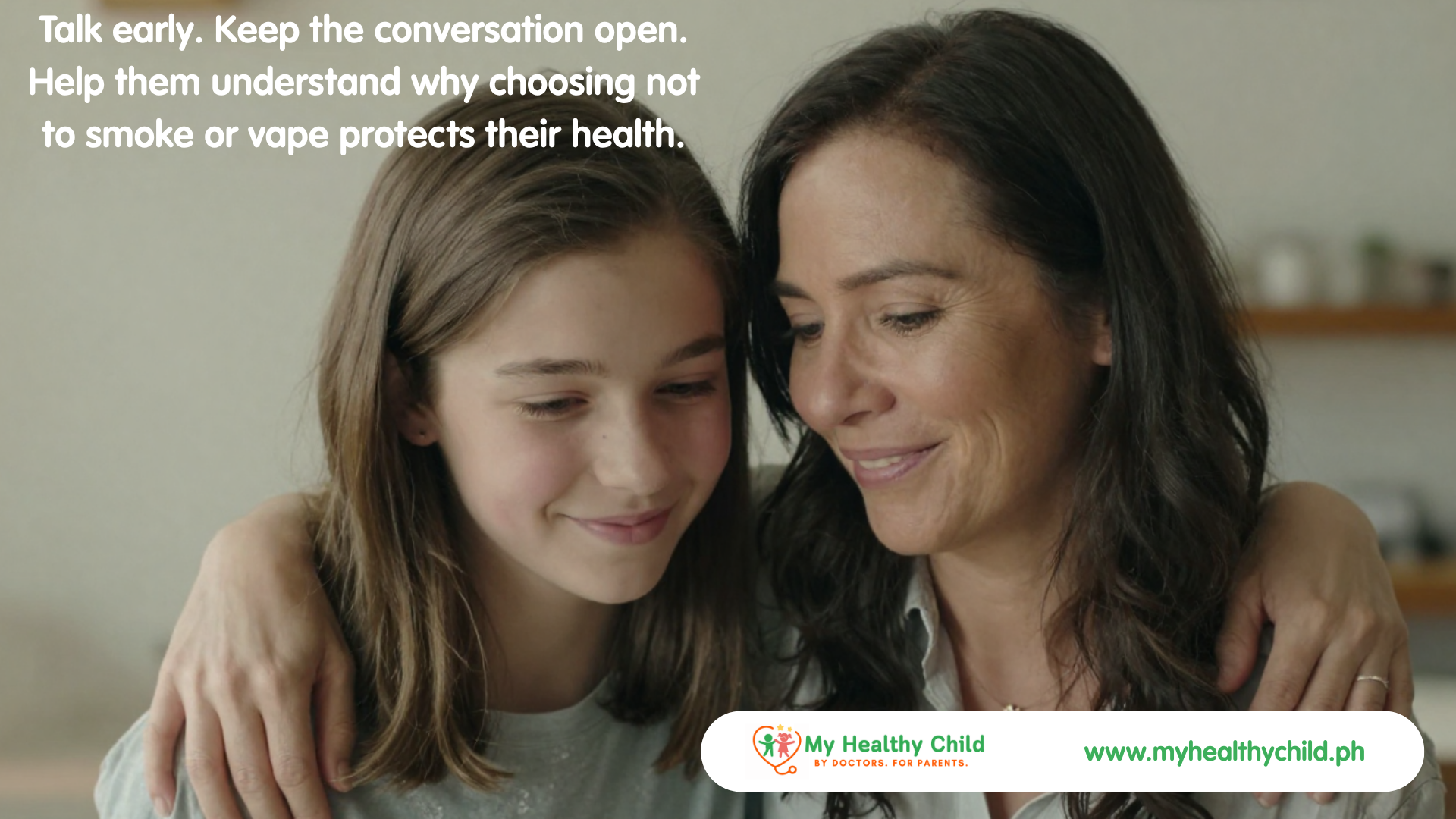
Talk early. Keep the conversation open. Know what your child is seeing and hearing.
And most importantly, help them understand why choosing not to smoke or vape protects their health.
References:
-
U.S. Department of Health and Human Services.E-Cigarette Use Among Youth and Young Adults: A Report of the Surgeon General. 2016.
-
Gordon T, et al.E-Cigarette Toxicology.Annu Rev Pharmacol Toxicol. 2022;62:301–322.
-
Drummond MB, et al.Electronic Cigarettes: Potential Harms and Benefits.Ann Am Thorac Soc. 2014;11(2):236–242.
-
Soneji S, et al.E-Cigarette Use and Subsequent Cigarette Smoking Among Adolescents and Young Adults.JAMA Pediatr. 2017;171(8):788–797.
-
Lindson N, et al.Electronic Cigarettes for Smoking Cessation.Cochrane Database Syst Rev. 2025.
-
Peterson LA, et al.Tobacco, E-Cigarettes, and Child Health.Curr Opin Pediatr. 2017;29(2):225–230.