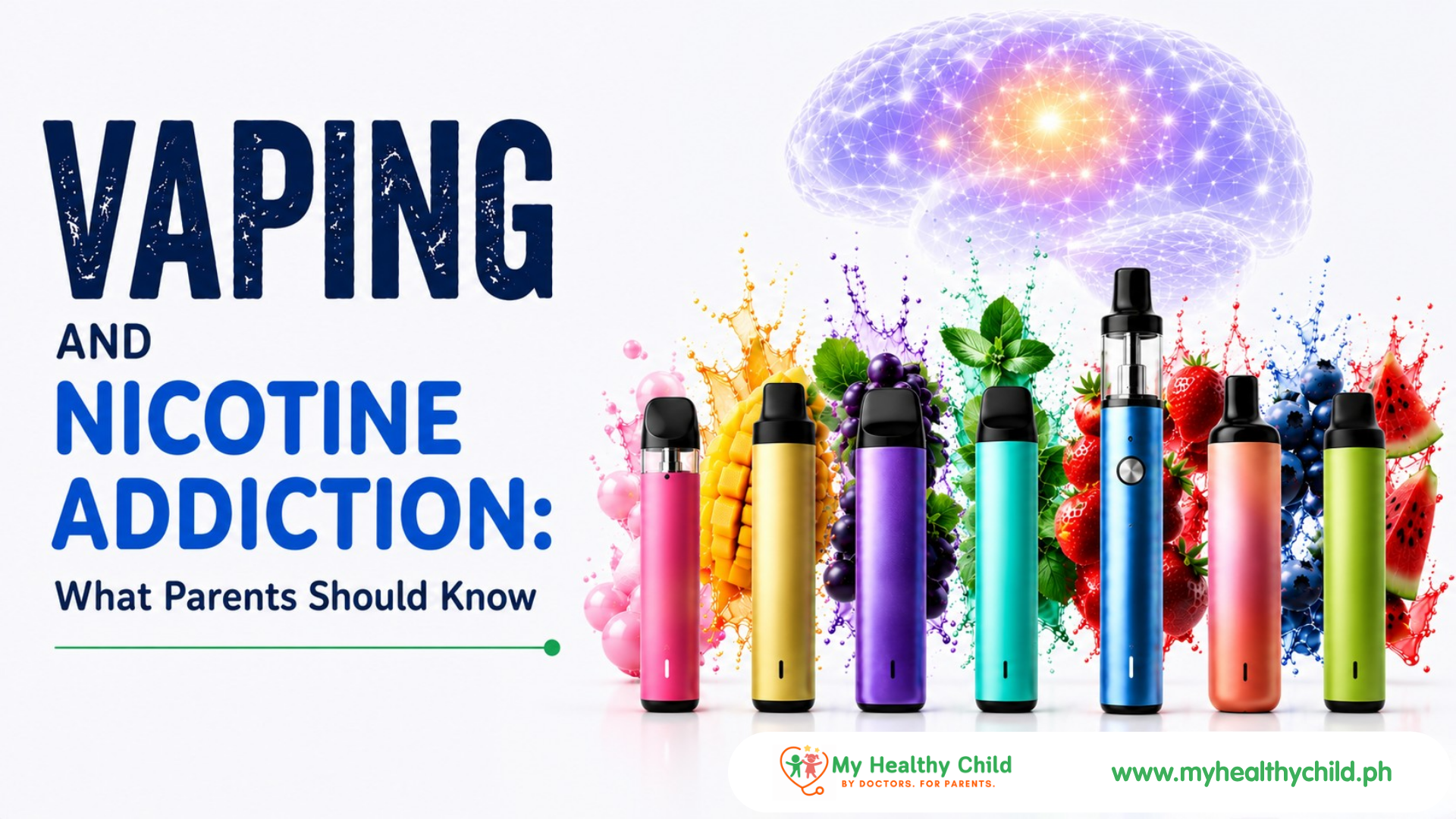
Vapes can be small, colorful, sweet-smelling and easy to conceal.
For a young person, they may seem very different from cigarettes—and possibly less concerning.
But there are two important facts parents should understand:
Vaping is not harmless. And when a vape contains nicotine, it can also lead to addiction.
Understanding the difference matters, especially because nicotine-free vaping products are also available.
Why can nicotine make vaping addictive?
Nicotine is the primary addictive substance found in cigarettes and many vaping products.
When nicotine reaches the brain, it interacts with nicotinic acetylcholine receptors and stimulates the release of dopamine, a chemical involved in the brain’s reward system.
That dopamine release can produce pleasurable sensations, reinforcing the behavior and encouraging repeated nicotine use.
With continued exposure, the brain can adapt. Over time, a person may need more nicotine to experience the same effect—a process known as tolerance.
When nicotine intake is reduced or stopped, withdrawal symptoms can occur, including:
- Irritability
- Anxiety
- Cravings
These changes can make quitting nicotine difficult.
What begins as experimentation can become dependence.
How addictive can e-cigarettes be?
A 2025 systematic review and meta-analysis examined evidence on e-cigarette dependence.
Across the studies reviewed, researchers found no statistically significant difference in the degree of addictiveness between e-cigarette users and traditional cigarette users.
The review also found that e-cigarette dependence was positively associated with nicotine concentration, frequency of use and duration of use.
In simple terms:
The more nicotine a vape contains—and the more frequently and longer it is used—the greater the concern for dependence.
This is one reason parents should not dismiss vaping as simply a habit that a young person can stop whenever they choose.
Nicotine-Free Doesn’t Mean Harmless
Because nicotine is responsible for nicotine dependence, parents may naturally wonder:
“What if the vape is nicotine-free?”
This requires an important distinction.
Without nicotine, a vape does not carry the same concern for nicotine addiction.
But that does not mean nicotine-free vaping is harmless.
A vape still works by heating an e-liquid or vape juice and producing an aerosol that is inhaled into the lungs.
E-liquids may contain ingredients such as:
- Propylene glycol (PG)
- Vegetable glycerin (VG)
- Flavoring chemicals
The toxicity of e-cigarette aerosol can come both from substances already present in the e-liquid and from chemicals produced when the liquid is heated by the device.
Potentially harmful substances identified in e-cigarette aerosols include aldehydes, volatile organic compounds, ultrafine particles and metals such as nickel, tin and lead.
So parents should separate two different questions:
Can nicotine make vaping addictive?
Yes. Nicotine is highly addictive.
Does removing nicotine make vaping harmless?
No. Vaping still involves inhaling an aerosol that may contain other potentially harmful substances.
NO NICOTINE DOESN’T MEAN NO RISK.
For children and teenagers, the healthiest choice is not to vape—whether or not the product contains nicotine.
Why should parents pay attention to nicotine concentration?
Not all vaping products contain the same amount of nicotine.
E-liquids can be sold in different nicotine strengths, and the amount of nicotine delivered can vary according to the product and how it is used.
This matters because evidence found that e-cigarette dependence was associated with higher nicotine concentration, more frequent vaping and longer duration of use.
A small or sleek vaping device should therefore not automatically be interpreted as meaning minimal nicotine exposure.
Why are vapes appealing to young people?
Understanding why young people vape can help parents have better conversations about it.
Several factors may make e-cigarettes attractive to adolescents, including:
- Attractive flavors
- Devices that are discreet and easy to conceal
- The perception that vaping is a less harmful alternative to cigarette smoking
- Peer and family influence
- Marketing on the internet
These factors can make vaping seem very different from traditional cigarette smoking.
A young person may therefore experiment with a vape without thinking of themselves as a “smoker” or considering the possibility of nicotine dependence.
Can vaping lead young people toward cigarette smoking?
This is another reason early experimentation deserves attention.
A systematic review and meta-analysis examined 17,389 adolescents and young adults aged 14 to 30 years.
Across the longitudinal studies included, e-cigarette use was associated with increased odds of subsequently starting cigarette smoking among adolescents and young adults.
This does not mean that every young person who vapes will eventually smoke cigarettes.
But it does reinforce why vaping should not simply be dismissed as harmless experimentation.
“My child says they can stop anytime.”
That may be true for some young people.
But once nicotine dependence develops, stopping may become more difficult.
The brain’s response to repeated nicotine exposure can contribute to tolerance, cravings and withdrawal symptoms.
Rather than assuming your child lacks discipline or simply needs to “stop,” consider whether nicotine dependence may be involved.
If your child is vaping regularly, experiencing strong cravings, or has tried unsuccessfully to stop, talk with your child’s pediatrician or another qualified healthcare professional.
How should I talk to my child about vaping?
You don’t need to begin with an accusation.
Start by finding out what your child already believes.
You might ask:
“What do kids your age think about vaping?”
“Do they think it’s safer than cigarettes?”
“Do they know that some vapes contain nicotine?”
“What have you heard about nicotine-free vapes?”
Listen first.
Then correct misconceptions calmly and clearly.
One of the most useful messages is:
“Nicotine is addictive. But nicotine isn’t the only reason vaping can be harmful.”
That distinction helps prevent another misconception—that choosing a nicotine-free vape somehow makes vaping harmless.
What if my child is already vaping?
Try to approach the situation as a health conversation rather than simply a disciplinary problem.
Find out:
- What product they are using
- Whether it contains nicotine
- How often they vape
- How long they have been vaping
- Whether they experience cravings
- Whether they have tried to stop
- Whether stopping causes irritability, anxiety or other difficulties
If you are concerned about nicotine dependence or your child’s vaping behavior, speak with their healthcare professional for appropriate assessment and guidance.
What Parents Should Remember
There are two separate issues parents should understand about vaping.
First: nicotine can be highly addictive.
Repeated nicotine exposure can reinforce continued use and lead to tolerance, cravings and withdrawal.
Second: nicotine-free doesn’t mean harmless.
Even without nicotine, vaping involves heating a liquid and inhaling an aerosol that may contain other potentially harmful substances.
Vaping is not harmless. And when nicotine is present, addiction becomes an additional risk.
For children and adolescents, the healthiest choice is not to start vaping.
References:
- Kundu A, et al. Evidence Update on E-Cigarette Dependence: A Systematic Review and Meta-analysis. Addict Behav. 2025;163:108243.
- Lopez-Ojeda W, et al. Vaping and the Brain: Effects of Electronic Cigarettes and E-Liquid Substances. J Neuropsychiatry Clin Neurosci. 2024;36(1).
- Gordon T, et al. E-Cigarette Toxicology. Annu Rev Pharmacol Toxicol. 2022;62:301–322.
- Sassano MF, et al. Evaluation of E-liquid Toxicity Using an Open-Source High-Throughput Screening Assay. PLoS Biol. 2018;16(3):e2003904.
- Soneji S, et al. Association Between Initial Use of E-Cigarettes and Subsequent Cigarette Smoking Among Adolescents and Young Adults. JAMA Pediatr. 2017;171(8):788–797.
- U.S. Department of Health and Human Services. E-Cigarette Use Among Youth and Young Adults: A Report of the Surgeon General. 2016.